Soda Peak Ingredients and Label Guide
The Supplement Facts panel in full, the arithmetic of the 82 mg blend, and a careful note on each of the nine ingredients.
The Supplement Facts panel
This is the panel as printed on the flat label artwork shown on the brand’s pages. We typed it out so it can be read on a phone and by a screen reader.
Supplement Facts
Serving Size: 1 Gummy
Servings Per Container: 30
| Item | Amount Per Serving | % Daily Value* |
|---|---|---|
| Calories | 10 | |
| Total Carbohydrate | 3 g | 1% |
| Total Sugar | 3 g | † |
| Includes 3g Added Sugar | 6% | |
| Sodium | 4 mg | <1% |
| Proprietary Blend | 82 mg** | † |
Muira Puama Extract, Maca Extract, Catuaba Extract, Green Tea Extract, Caffeine (5 mg), Ashwagandha, L-Arginine, Tribulus Terrestris, Horny Goat Weed Extract.
† Daily Value not established
*Percent Daily Values are based on a 2,000 calorie diet.
** equivalent to approximately 567mg of dry powders.
Other Ingredients: Corn Syrup, Cane Sugar, Water, Apple Pectin, Sorbitol Liquid, Natural Flavors, Citric Acid, Sodium Citrate Dihydrate.
Serving size and what one gummy adds
The serving is 1 gummy and a bottle holds 30 servings. Each gummy has 10 calories and 3 g of total carbohydrate, all of it sugar and all of that added sugar.
The label gives the added sugar as 6% of the Daily Value. That matches the FDA’s reference figure: the agency puts the Daily Value for added sugars at 50 grams a day, and 3 ÷ 50 is 6%. Over a bottle, the gummies add up to 90 g of added sugar and about 300 calories.
What the 82 mg blend does and does not tell you
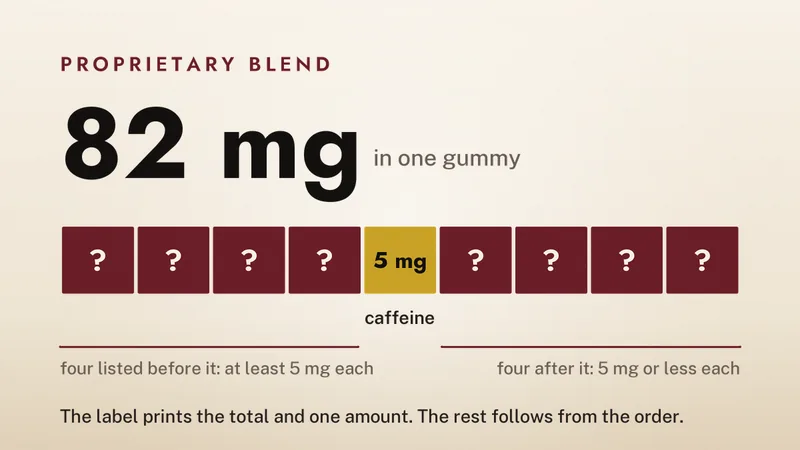
A proprietary blend shows one total weight for a group of ingredients. The FDA’s labeling guide requires the ingredients in a blend to be listed in descending order of predominance by weight. That rule, plus the one amount the label does print (caffeine, 5 mg), is enough to work out limits for the rest.
- The blend is 82 mg. Take away the 5 mg of caffeine and 77 mg is left for the other eight ingredients, an average of about 9.6 mg each.
- Caffeine is fifth of nine. The four listed after it (ashwagandha, L-arginine, tribulus terrestris, horny goat weed) can each be no more than 5 mg, so together no more than 20 mg.
- The four listed before it (muira puama, maca, catuaba, green tea extract) must each be at least 5 mg and together make up between 57 and 77 mg.
- Muira puama, listed first, is therefore somewhere between 14.25 mg and 62 mg.
The label adds a footnote: the 82 mg is “equivalent to approximately 567mg of dry powders”. That is how concentrated extracts are often described, meaning a small weight of extract was made from a larger weight of plant material. It is the seller’s statement and the label does not give extract ratios.
The nine ingredients, one by one
For each ingredient we separate three things: what the label says, what the ingredient is, and what a general reference says, if we found one worth citing. None of the references studied Soda Peak itself, and the amounts in their studies are not known to match the amounts in this gummy.
Muira Puama Extract
On the label: First on the list, so by the labeling rule it is the heaviest ingredient in the blend: between 14.25 and 62 mg by our arithmetic below.
What it is: Muira puama is a shrub native to the Brazilian Amazon whose bark and root are used in traditional herbal preparations.
What can be said: The brand says it supports physical strength and circulation. We did not find a U.S. government fact sheet on it, so we repeat no health claim for it here.
Maca Extract
On the label: Second on the list.
What it is: Maca is a root vegetable grown in the Peruvian Andes, eaten as a food and sold as a powder or extract.
What can be said: The brand calls it an adaptogenic superfood for steady energy. That is the seller’s description; the label gives no amount and we cite no study for it.
Catuaba Extract
On the label: Third on the list.
What it is: Catuaba is the name given to the bark of several Brazilian trees used in traditional tonics.
What can be said: The brand links it to endurance. The label does not say which species is used or how much.
Green Tea Extract
On the label: Fourth on the list, and therefore at least 5 mg.
What it is: A concentrate made from the leaves of the tea plant; it naturally contains catechins and some caffeine.
What can be said: NCCIH says definite conclusions cannot yet be reached on whether green tea is helpful for most of the purposes it is used for, and that liver injury, although uncommon, has been reported with green tea extracts taken as tablets or capsules. Side effects listed for extract supplements include nausea, abdominal discomfort and increased blood pressure.
Caffeine (5 mg)
On the label: The only ingredient with its own printed amount.
What it is: A stimulant found in coffee, tea, cola and cacao.
What can be said: MedlinePlus gives 95 to 200 mg for an 8-ounce cup of coffee and says up to 400 mg a day is not harmful for most people. At 5 mg, the gummy adds little, but it does add to your daily total, and the green tea extract contributes some more that the label does not quantify.
Ashwagandha
On the label: Listed after caffeine, so 5 mg or less.
What it is: A shrub used in Ayurvedic practice; supplements are usually made from the root.
What can be said: NCCIH says some ashwagandha preparations may be effective for insomnia and stress, and that limited evidence suggests taking it for 2 to 4 months may increase testosterone levels and sperm quality. It also notes possible drowsiness, stomach upset, rare cases of liver injury, and interactions with several kinds of medicine. Studies used their own preparations and doses, which are not known to match this gummy.
L-Arginine
On the label: Listed after caffeine, so 5 mg or less.
What it is: An amino acid found in protein foods such as meat, fish, eggs, dairy and legumes.
What can be said: The NIH Office of Dietary Supplements notes that a nutritious diet supplies about 4 to 5 grams a day. Five milligrams is about a thousandth of that, so the amount in one gummy is small beside what food already provides.
Tribulus Terrestris
On the label: Listed after caffeine, so 5 mg or less.
What it is: A plant whose compounds some sellers claim raise hormone levels, including testosterone.
What can be said: The NIH Office of Dietary Supplements says the few studies of tribulus for strength or muscle mass did not find a benefit, and that it has not been studied enough to know whether it is safe.
Horny Goat Weed Extract
On the label: Last on the list, so the lightest ingredient in the blend.
What it is: The common name for plants of the genus Epimedium, used in traditional Chinese herbal practice.
What can be said: The brand’s sales page does not describe it at all, and we cite no health claim for it.
The brand’s sales page describes six of these ingredients. The label lists nine. We follow the label.
Other ingredients
Corn Syrup, Cane Sugar, Water, Apple Pectin, Sorbitol Liquid, Natural Flavors, Citric Acid, Sodium Citrate Dihydrate.
These make the gummy itself: sweeteners (corn syrup, cane sugar), water, a gelling agent (apple pectin), a humectant (sorbitol), flavor, and acidity regulators (citric acid, sodium citrate). Gelatin is not listed. Sorbitol is a sugar alcohol; the amount is not stated.
Allergens
The label artwork we read carries no “Contains” statement. If you have a food allergy, ask the seller at [email protected] about the manufacturing facility before ordering.
Warnings and storage
- If you are pregnant or nursing, take medications or have a medical condition, consult your doctor before using.
- Discontinue use and consult your doctor if any adverse reactions occur.
- Keep out of the reach of children. The gummies look like candy, so store them accordingly.
- Store at room temperature, 59-86°F (15-30°C), and keep the bottle tightly closed.
- Do not use if the seal under the cap is broken or missing.
What cannot be concluded
The label tells you what is in the gummy and, for most ingredients, not how much. General references describe single ingredients at their own doses. Neither tells you what the finished product does. The brand’s pages do not show a clinical study of Soda Peak, and this site makes no claim that it treats, cures or prevents anything.
Sources
- Product source: the Soda Peak bottle and flat label artwork shown by the brand, its sales and order pages, the seller's return policy and the BuyGoods checkout, read on November 20, 2026.
- General reference: U.S. Food and Drug Administration. Dietary Supplement Labeling Guide: Chapter IV. Nutrition Labeling.
- General reference: U.S. Food and Drug Administration. Added Sugars on the Nutrition Facts Label.
- General reference: MedlinePlus, U.S. National Library of Medicine. Caffeine.
- General reference: National Center for Complementary and Integrative Health. Green Tea: Usefulness and Safety.
- General reference: National Center for Complementary and Integrative Health. Ashwagandha: Usefulness and Safety.
- General reference: NIH Office of Dietary Supplements. Dietary Supplements for Exercise and Athletic Performance: Fact Sheet for Consumers.
- General reference: U.S. Food and Drug Administration. Questions and Answers on Dietary Supplements.
- Our own arithmetic: totals, cost per day, percentages and blend limits are calculated from the prices and label values above.